

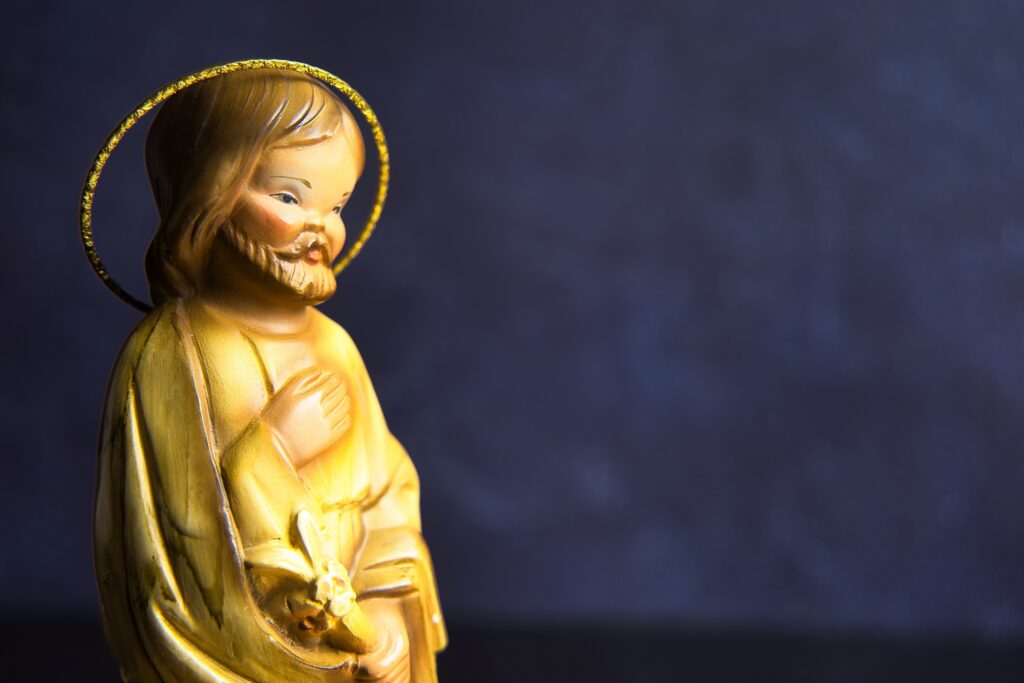
Saint Joseph’s Day, Staten Island Style
I spent part of my morning in a place that feels, to me, like holy ground, our local Italian bakery. The air was thick with powdered sugar and espresso, and the glass cases were filled with Saint Joseph’s pastries, rolls, and bread. It was the kind of place where tradition isn’t just remembered; it’s lived.
Saint Joseph’s Day has always been about more than desserts, of course. But I’d be lying if I said the pastries didn’t help. Traditions like these have a way of grounding us, especially when life feels unpredictable, or when our bodies and circumstances don’t always cooperate with the plans we had in mind.
Our Very Own “Saint Joe”
And it may surprise you, but in our house, we have our very own Saint Joseph.
My husband, Joe, is often referred to as “saint” by members of the Staten Island community.
Don’t believe me?
A dear friend once gave him a birthday gift featuring his face superimposed onto the body of Saint Joseph. And no—this is not blasphemy. It’s Staten Island.
It seems those who know us best believe there is good reason Joe has earned his saintly title. Apparently, some folks think it might be slightly challenging being married to me.
I know. I was shocked too.
Clearly, my sparkling personality, charming wit, and outgoing nature can be a bit much for some people. But not for my husband—good ol’ Saint Joe.
Over the years, he has embraced a few additional titles:
“Mr. Holly Bonner.”
“Holly Bonner’s Husband.”
“The Uber Driver.”
And my personal favorite, “The Preacher’s Husband.”
And if you’ve ever lived with disability, or loved someone who does, you know those titles aren’t just jokes. They’re job descriptions. They speak to flexibility, to patience, to the quiet, daily adjustments that rarely get noticed but make everything else possible.
The Staten Island version of Saint Joseph is a man who can take a joke, make fun of himself, love his children unconditionally, provide for his family, and never bat an eye when his wife occasionally sucks all the air out of a room.
Honestly, Joe’s parents could not have picked a more fitting name.
The Saint Who Says Nothing
Because Saint Joseph—the original—is the patron saint of husbands, fathers, families, homes, and workers. He’s also known as a protector in times of uncertainty, something anyone navigating illness, disability, or unexpected life changes understands all too well.
And yet, for someone so important, we know remarkably little about him.
Joseph never speaks a single word in the Gospels.
Not one.
Everything we know about him comes from what he does, not what he says.
We know he was a carpenter. We know he lived in Nazareth. We know he was engaged to Mary and discovered she was pregnant before they lived together. And instead of shaming her, he chose mercy. He decided to quietly step away.
The Gospel tells us he did this because he was a righteous man.
But then—God spoke to him in a dream.
And Joseph listened.
He takes Mary as his wife.
He travels to Bethlehem.
He flees to Egypt.
He builds a life he never planned.
Joseph’s story is, in many ways, a story of adaptation. Of letting go of what you thought your life would look like and stepping into what it actually is. And that kind of faith, the kind that adjusts, that bends without breaking, is something many of us know intimately.
Faith That Shows Up
Joseph is not a man of words. He is a man of action.
And that matters.
Because faith, for many of us, is not loud or polished. It doesn’t always look like certainty or strength. Sometimes it looks like getting out of bed when your body resists. Sometimes it looks like asking for help. Sometimes it looks like staying.
It is quiet.
It is persistent.
It is showing up.
Imagine the complexity of Joseph’s life. Raising a child who is not biologically yours – but is, quite literally, the Son of God. Teaching him how to walk, how to work, how to live.
When Jesus took his first steps—Joseph was there.
When the family needed food—Joseph was there.
When it was time to learn a trade—Joseph was there.
No spotlight. No recognition. Just presence.
And that kind of presence—the kind that sustains, that adapts, that remains—is sacred.
Joseph reminds us that caregiving, in all its forms, is not secondary work. It is holy work.
Scripture simply calls him “his father.”
Not foster father.
Not stepfather.
Just father.
God Uses the Ordinary
In a world that often measures worth by productivity, independence, or perfection, Saint Joseph offers us another way.
A quieter way.
A steadier way.
A faithful way.
He reminds us that our value is not in how much we can produce, but in how faithfully we love.
Joseph was a simple carpenter. Not wealthy. Not powerful. Not extraordinary by the world’s standards.
And yet God entrusted him with everything.
That should give all of us hope.
Because sometimes our lives look smaller than we imagined. Sometimes our abilities shift. Sometimes we feel like we are no longer who we once were.
But Joseph’s life tells us this: God’s plan is not limited by our limitations.
God works through the quiet ones.
The steady ones.
The ones who keep showing up.
The ones like Joseph.
And yes—even the “Preacher’s Husband” on Staten Island.
So today, as you celebrate Saint Joseph’s Day—whether with pastries, prayer, or both—take a moment to honor the quiet faithfulness in your own life.
Say a prayer to Saint Joseph.
A father among fathers.
A worker among workers.
A man who never needed words to be faithful.
And remember: there might just be a little Saint Joseph in all of us.