

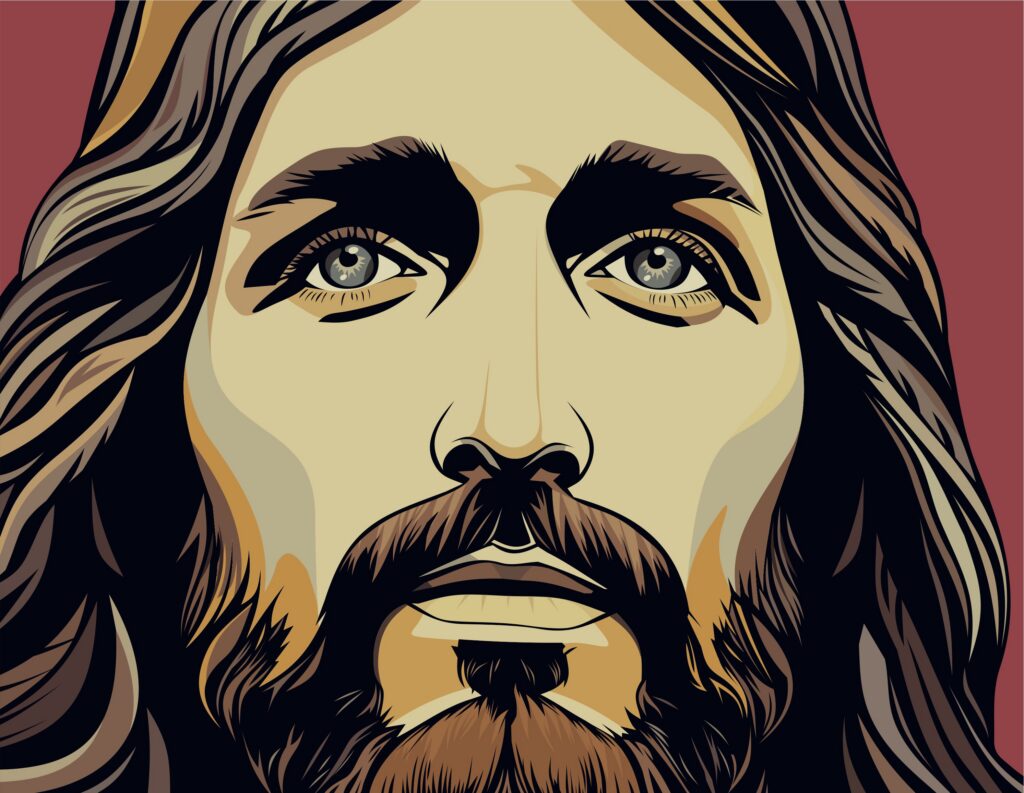
How Do You See Jesus?
When you close your eyes and picture Jesus, what does He look like?
For some, He is robed in flowing linen, light pooling around his shoulders like a Renaissance painting. For others, He looks like Jonathan Roumie from The Chosen, soft-eyed, solemn, holy in a way that feels cinematic.
But when I imagine Jesus, I don’t see a tunic.
I see blue jeans.
Not crisp, straight-from-the-store jeans. I see the kind that are so well-worn the knees are almost translucent, that soft, light denim that only comes from years of kneeling, sitting on porches, and walking long roads. The kind of jeans that have known life.
On his feet, I picture Birkenstocks. Because honestly, when it comes to footwear, would Jesus really choose anything else? Practical. Comfortable. Made for walking. Made for standing with people.
He’s wearing a white V-neck T-shirt. Nothing glowing. Nothing dramatic. Just soft cotton, familiar and easy. Comfy casual at its best.
He has a beard over His olive skin. His hair is long. There are laugh lines around his mouth, and when He smiles, His hazel eyes crinkle at the corners. He looks like someone who has spent a lifetime listening…really listening… to people’s stories.
And sometimes, when I picture Him, there’s a dog at his feet.
A retired guide dog.
She looks like my first guide, Franny.
Franny was a yellow lab with the sweetest disposition. She was the color of vanilla pudding, soft gold in the sunlight. She lived to please. Her whole being radiated devotion and joy. She worked hard for me, and when she retired, she settled into a gentler rhythm, content just to be near.
Franny passed away two years ago and when she died a piece of my soul went with her.
If you’re wondering, “Does Jesus really need a retired guide dog?”
Probably not.
But I think he would enjoy the company.
And I think the people waiting to see Him would love a furry face to greet them when they arrive.
There is something profoundly comforting about imagining Jesus not only as Savior and Lord, but as someone whose presence feels like home. Someone approachable. Someone embodied in a way that makes room for our lives, including the parts shaped by disability.
For centuries, Christian art has given us one dominant image: able-bodied, symmetrical, strong. Even the crucifixion is often rendered with aesthetic balance. Jesus’ wounds are there, yes — but stylized. Clean. The suffering is beautiful in a way that suffering rarely is.
Because here is the deeper question beneath all of this: When disabled people imagine Jesus, do they see themselves reflected in Him?
Would He use a wheelchair?
Would He have an amputation?
Would He walk with a cane?
Would He know chronic pain?
Would He navigate a world not built for His body?
These are not irrelevant questions. They are incarnational ones.
Christian faith rests on the astonishing claim that God took on flesh – real flesh. Vulnerable flesh. A body that got tired and hungry. A body that sweat and bled. A body that carried trauma.
After the Resurrection, Jesus still had scars.
Thomas was invited to touch them.
The risen Christ was not scrubbed clean of bodily history. His wounds were not erased. They were transformed — but they remained.
That matters.
For disabled Christians, the idea that Jesus keeps his scars opens a holy door. It suggests that bodily difference is not something shameful or temporary. It is not something that must be erased before it can be made holy.
The scars stay.
So, when I imagine Jesus in worn jeans and Birkenstocks, I’m not diminishing him.
I’m locating him.
I’m placing him somewhere accessible. Somewhere I could sit down beside him without feeling intimidated. Somewhere, my disability is not the most remarkable thing about me.
And when I picture him with a retired guide dog at his feet, I’m imagining a Savior who delights in companionship; who honors the partnerships that shape our lives.
Guide dogs are not just mobility tools. They are relationship. Trust. Mutual dependence. They are quiet miracles of training and devotion. They know the subtle cues of our bodies. They adjust their pace to ours. They stand steady when we falter.
What if Jesus, in his gentleness, would cherish that kind of presence?
What if heaven includes not just restored sight and healed limbs, but restored relationships, including the animals who walked with us through this life?
Disabled theology often wrestles with a tension. So many Gospel stories center on healing. Blind people see. Lame people walk. Bodies are restored to what society recognizes as “normal.”
For some, those stories bring hope.
For others, they raise complicated feelings.
Is disability always something to be fixed?
Or can it also be something that reveals God?
What if we allowed ourselves to focus on Jesus’ scars?
Would that diminish Him?
Or would it finally tell the truth, that God fully inhabits human vulnerability?
When I picture Jesus with laugh lines and soft denim and a retired yellow lab at his feet, I am not trying to modernize him.
It’s my way of recognizing him.
Because the Jesus who meets me in prayer does not feel distant or polished. He feels grounded. Present. Comfortable in my living room. Comfortable in my body.
He does not flinch at white canes or wheelchairs or feeding tubes or service dogs. He does not see disability as a metaphor. He sees people.
He sees us.
And perhaps the most important thing about imagining Jesus this way is this: it allows disabled people to imagine ourselves in heaven without first being erased.
When I meet Jesus someday, and Franny runs ahead of me, tail wagging, golden fur bright in eternal light, I do not think He will scold my imagination.
I think He will laugh.
I think His eyes will crinkle at the corners.
I think He will kneel down in those worn jeans, scratch her ears, and say, “I’m glad you’re both here.”
Because maybe what matters most is not what Jesus is wearing.
Not whether he chooses sandals or tunics.
But whether we can see Him in a way that helps us believe He sees us.
Fully.
Tenderly.
Without requiring us to change first.
A Savior who keeps His scars is a Savior who understands ours.
And a Savior whose kingdom is wide enough for retired guide dogs is a Savior whose love is wide enough for EVERY BODY.